
Abstract
Corporate GPT is an enterprise knowledge assistant that answers questions strictly from an organization's own documents rather than from a language model's parametric memory. This paper describes its agentic Retrieval- Augmented Generation (RAG) architecture: a top-level orchestrator that plans, delegates to specialized sub-agents, and enforces a grounding contract; a two-stage preview → select → answer retrieval flow that keeps a human in the loop; a hybrid (dense + sparse) retrieval engine backed by the Qdrant vector database with LLM-based reranking under a “deep search” mode; and defense-in-depth access control that enforces per-user, per-group, and per-project document authorization on every query. We also cover the asynchronous ingestion pipeline, PII/PHI redaction, and the provider-agnostic model layer that lets the same architecture run against self-hosted or commercial models. The design goals throughout are groundedness (never fabricate), authorization (never leak), and observability (every retrieval is traced).
 View full size

Read figure text
Groundedness Never fabricate. | Authorization Never leak. | Observability Every retrieval is traced.
Introduction
Large language models (LLMs) are fluent but unreliable narrators of private enterprise knowledge: they hallucinate facts, cannot cite sources, and have no notion of who is authorized to see what. Retrieval-Augmented Generation (RAG) mitigates the first two problems by grounding generation in retrieved passages, but a naive “embed, search, stuff-the-prompt” pipeline is insufficient in a corporate setting. Real deployments must additionally decide whether to retrieve, where to retrieve from, how many times, and for whom, and they must do so while respecting document-level access control and regulatory constraints on personal data.
 View full size

Read figure text
Whether to retrieve | Where to retrieve from | How many times bounded multi-hop | For whom document-level access control
Corporate GPT addresses these requirements with an agentic RAG design. Rather than a fixed retrieval chain, an orchestrating LLM agent reasons about each request, routes it to the appropriate specialized sub-agent (document RAG, web search, SQL, Jira, ticketing), and controls a bounded multi-hop retrieval loop. Retrieval itself is hybrid, combining dense semantic vectors with sparse lexical (BM25) matching, and can escalate to an LLM-reranked “deep search” when precision matters. Critically, every retrieval is filtered through an access-control layer derived from the requesting user's identity, group membership, role, and project scope, and the corpus is scrubbed of sensitive personal data at ingestion time.
This paper documents that architecture as implemented, describing the concrete components, data flow, and design decisions that make retrieval grounded, authorized, and observable.
System overview
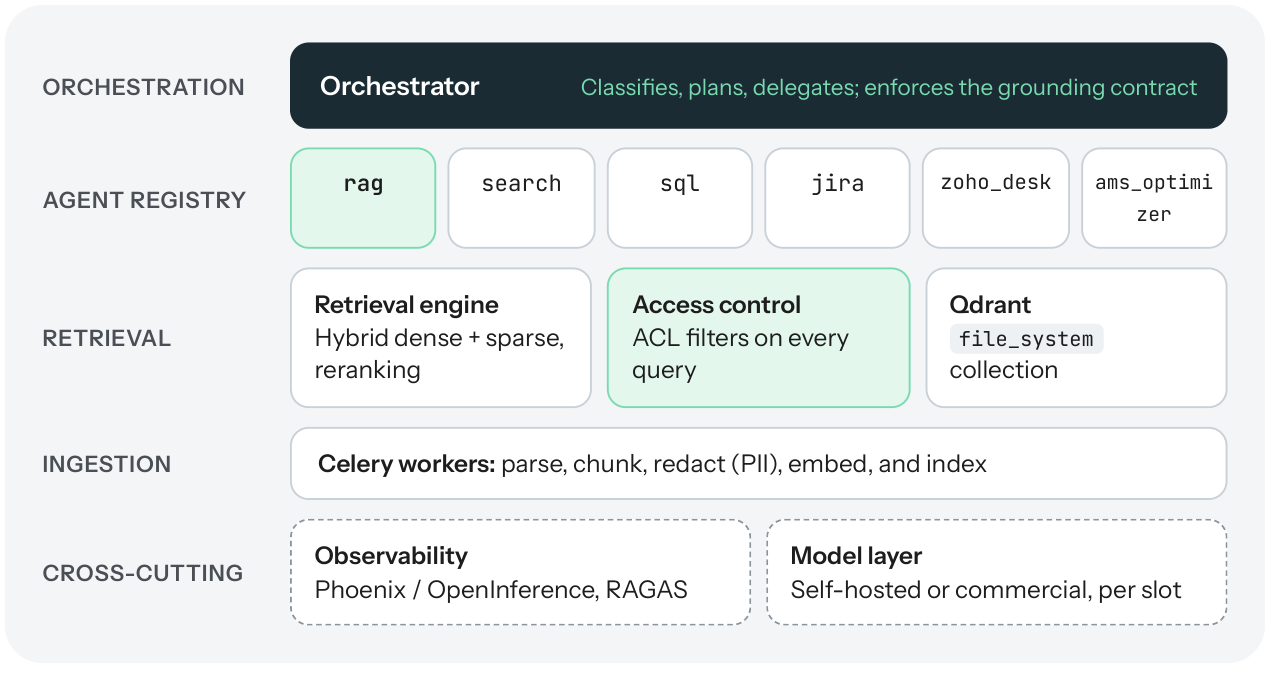
Corporate GPT is a multi-agent system in which the underlying model provider (self-hosted open models or a commercial API such as Claude) is a deployment-time choice rather than a fixed dependency. The major subsystems are:

Read figure text
ORCHESTRATION Orchestrator Classifies, plans, delegates; enforces the grounding contract search sql jira zoho_desk ams_optimi rag AGENT REGISTRY zer Retrieval engine Access control Qdrant RETRIEVAL Hybrid dense + sparse, ACL filters on every file_system reranking query collection INGESTION Celery workers: parse, chunk, redact (PII), embed, and index Observability Model layer CROSS-CUTTING Phoenix / OpenInference, RAGAS Self-hosted or commercial, per slot
 View full size

Read figure text
Orchestrator A top-level chat agent that classifies the request, plans, and delegates to sub-agents exposed as tools. | Agent registry A plug-and-play discovery mechanism that loads enabled agents from the filesystem and can run each one either in-process (embedded) or as a remote A2A (agent-to-agent) service.
 View full size

Read figure text
RAG agent Grounded question answering over indexed documents, backed by the retrieval engine. | Retrieval engine Hybrid dense+sparse search over Qdrant, with reranking, deduplication, stitching, and context budgeting.
 View full size

Read figure text
Ingestion pipeline Asynchronous Celery workers that parse, chunk, redact (PII), embed, and index documents. | Access control ACL metadata filters applied to every query.
 View full size

Read figure text
Observability Phoenix / OpenInference distributed tracing and RAGAS-based evaluation.
2.1 The agent registry
The registry discovers every agent package on startup. The set of active agents is driven purely by environment configuration (ENABLED_AGENTS) and the filesystem, so the system topology can be reconfigured without code changes. For each enabled agent, a per-agent <NAME>_MODE selects an embedded in-process instance or a remote RemoteA2aAgent reached over the network. The currently shipped agents include:
| Agent | Responsibility |
|---|---|
| rag | Grounded QA over indexed corporate documents (Qdrant) |
| search | Web-search fallback (Brave) for public/current info |
| sql | Natural-language querying over relational databases |
| jira | Retrieval over Jira tickets, issues, and sprints |
| zoho_desk | Retrieval / actions over Zoho Desk support tickets |
| ams_optimizer | Domain-specific optimization agent |
This decoupling is what makes the system agentic at the architectural level: the orchestrator does not hard-code a pipeline; it composes whatever tools the registry currently exposes.
The agentic orchestration layer
The chat orchestrator is itself an agent. It wraps each enabled sub-agent as a callable tool (the RAG agent, and, when enabled, the Brave web searcher, the Jira agent, the AMS optimizer, and the Zoho Desk agent) and loads a natural-language operating instruction (a “skill”) that governs how it reasons. The orchestrator's job is planning and delegation: it decides which tool answers the current turn and enforces the system-wide grounding contract.
3.1 The grounding contract
The orchestrator's instruction encodes an absolute rule: it is not a general-knowledge assistant and must never answer a substantive question from its own training data. Every non-trivial answer must be grounded in either (a) retrieved document chunks from the RAG agent, or (b) web-search results (and only when web search is explicitly enabled). The only messages it may answer directly are pure greetings and chitchat that carry no information request. When the system cannot ground an answer, it is required to say so rather than fabricate: surfacing the document preview or an explicit “could not find relevant information” result instead of a hallucination.
 View full size

Read figure text
(a) Retrieved document chunks from the RAG agent | (b) Web-search results, only when web search is explicitly enabled | Otherwise Say so rather than fabricate | GROUNDING CONTRACT
3.2 Two-stage retrieval: preview → select → answer
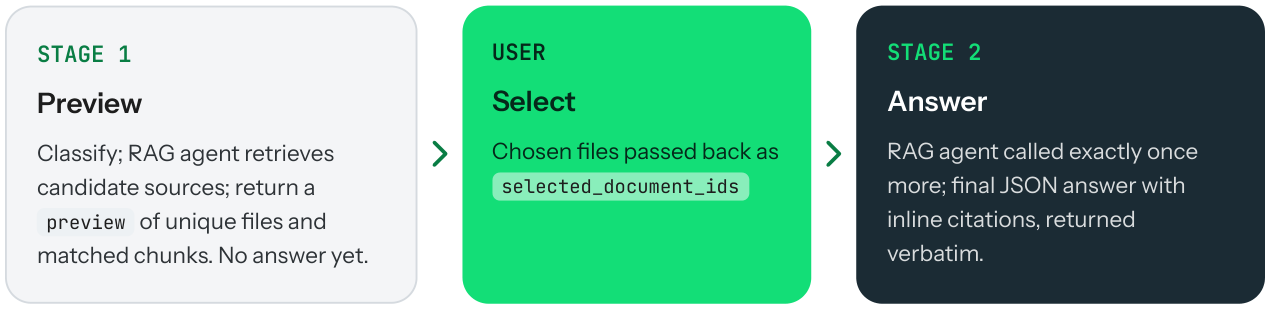
A distinctive feature of Corporate GPT is that document retrieval is a two-stage, human-in-the-loop flow rather than a single hidden call. This keeps the user in control of provenance and prevents the model from silently answering from the wrong document.
Stage 1: Initial (preview mode). On the first turn the orchestrator classifies the message into exactly one of: greeting/chitchat (answer directly); a web question (delegate to the web searcher, verbatim); a Jira question (single-shot delegate to the Jira agent, verbatim); or (the default for anything factual, informational, or company-specific) a RAG-relevant question. For RAG-relevant questions, the orchestrator calls the RAG agent to retrieve candidate sources, but does not yet generate an answer. Instead it returns a preview object listing the unique files and the specific chunks that matched, and asks the user to select which documents to answer from.
 View full size

Read figure text
Greeting / chitchat Answer directly | Web question Web searcher, verbatim | Jira question Jira agent, single-shot, verbatim | RAG-relevant The default for anything factual
Stage 2: Continue (answer mode). Once the user selects files, those selections are passed back as selected_document_ids. The orchestrator calls the RAG agent exactly once more; the agent retrieves strictly from the selected, access-controlled documents and produces the final JSON answer with inline citations. The orchestrator returns this response verbatim: it must not re-summarize, re-order, deduplicate, or wrap the sub-agent's grounded output, so the answer the user sees is byte-for-byte what the retrieval agent produced.

Read figure text
STAGE 1 Preview Classify; RAG agent retrieves candidate sources; return a preview of unique files and matched chunks. No answer yet. | USER Select Chosen files passed back as selected_document_ids | STAGE 2 Answer RAG agent called exactly once more; final JSON answer with inline citations, returned verbatim.
The answer the user sees is byte-for-byte what the retrieval agent produced.
3.3 Bounded multi-hop retrieval and tool-choice control
Within the RAG agent, retrieval is a controlled loop rather than a single shot. A tool-choice policy decides, on each model step, whether tool use is forced, forbidden, or optional. The decision is a pure function of the conversation state and resolves in the following precedence:
 View full size

Read figure text
1. NONE For a greeting turn, or once the retrieval budget is spent, or a file-export cap is hit. A looping model is cut off and must answer with what it already has. The first hop of a non-thinking turn is forced to call the retrieval tool, so 2. ANY(retrieve) the agent can never answer before grounding. When the user asked for a downloadable artifact, sources were found, 3. ANY(file creators) and no creator has yet run. 4. AUTO Otherwise, the model chooses freely.
This policy is enforced at the model-invocation layer, binding the model's native tool-choice controls rather than merely suggesting behavior in the prompt, which makes grounding a hard invariant. A configurable budget (default 10 retrievals per user query) bounds the loop; both successful and failed retrieval attempts increment the counter so that a persistently failing query terminates gracefully with a “retrieval failed” answer instead of looping to the model-call limit. When the deployment enables an extended reasoning (“thinking”) mode, the agent is trusted to retrieve on its own initiative and the forced-first-hop rule is relaxed.
The retrieval engine
The retrieval engine owns the Qdrant connection, the embedding model, the reranker, and the document and summary indexes, and mediates every query against the corpus.
4.1 Hybrid dense + sparse search
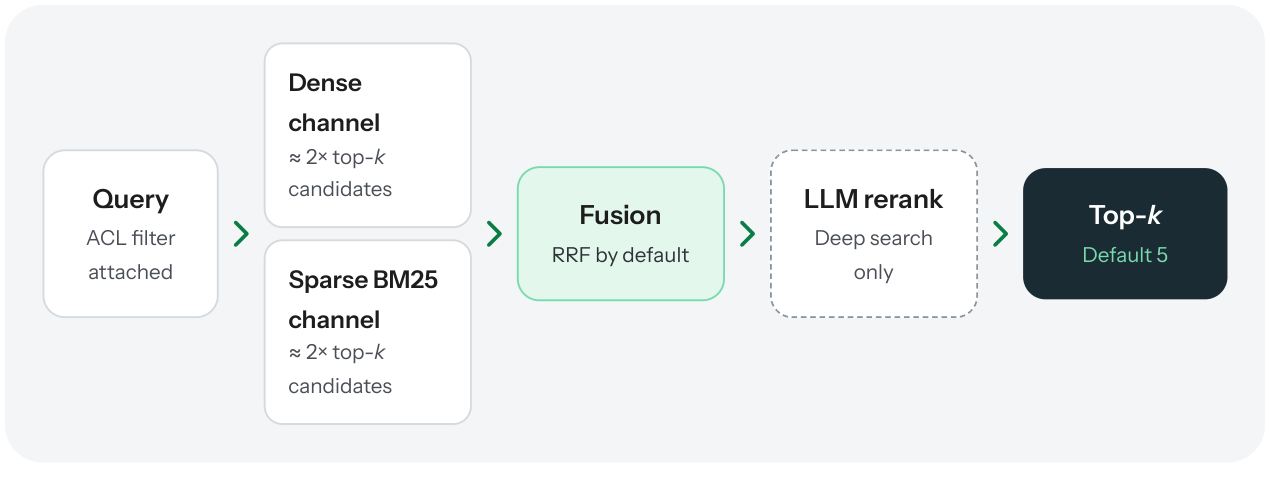
Documents are indexed into a single unified Qdrant collection (default name file_system) with native hybrid search enabled. Each query is answered by combining two retrieval channels:
 View full size

Read figure text
Dense (semantic) A neural embedding of the query is matched against chunk embeddings by vector similarity. The embedding model is resolved from configuration (e.g. a Qwen3- Embedding model served via vLLM/Ollama), so the semantic space is a deployment choice. | Sparse (lexical, BM25) A sparse text embedding (fastembed 's SparseTextEmbedding) provides exact-term matching, which recovers rare identifiers, codes, and acronyms that dense vectors blur together.
The sparse channel uses a BM25 sparse encoder (default Qdrant/bm25, loaded from a local cache first to avoid a network fetch on startup). The two ranked lists are combined by a configurable fusion strategy. The system implements three, selectable via QDRANT_HYBRID_FUSION:
 View full size

Read figure text
Reciprocal Rank Fusion (RRF) DEFAULT The default; each document's fused score is computed as below, with k = 60 by default. Rank-based fusion is robust to incomparable score scales. k = 60 fused score = ∑i αi / (k + ranki)
 View full size

Read figure text
Distribution-Based Score Fusion (DBSF) Per-channel μ ± 3σ normalization then a weighted sum, mirroring Qdrant's server-side DBSF. | Relative Score Fusion Min-max style normalization, wrapped to handle the degenerate both-channels-empty case safely.
The engine requests roughly twice the requested top-k from each channel before fusion, giving the fusion and downstream reranking stages a larger candidate pool to work from. The default answer size is DEFAULT_TOP_K = 5.

Read figure text
Dense channel ≈ 2× top-k candidates Query LLM rerank Top-k Fusion ACL filter Deep search RRF by default Default 5 attached only Sparse BM25 channel ≈ 2× top-k candidates
4.2 Deep search: LLM reranking
When a query needs higher precision, the caller enables deep search. In this mode the engine doubles the candidate pool (2× top-k) and then applies an LLM-based reranker (LlamaIndex LLMRerank) driven by a no-thinking “parser” LLM to re-score and select the best top-k passages. Because reranking feeds full chunk text to the LLM, the engine token-budgets each candidate before the rerank call (computing a per-node budget from the parser's context window divided by the batch size) and restores the full untruncated content of the surviving nodes afterward, so the downstream answer generator still sees complete passages. Reranking runs on a dedicated background event loop with a timeout; if it times out, the engine gracefully falls back to the pre-rerank ordering.
 View full size

Read figure text
2× top-k candidates Token-budget each LLMRerank Restore full content
 View full size

Read figure text
Best top-k
On timeout, the engine falls back to the pre-rerank ordering.
4.3 Post-retrieval processing
Beyond fusion and reranking, several passes improve answer quality and robustness:
 View full size

Read figure text
Same-page stitching Adjacent nodes from the same page are stitched so a passage split across chunk boundaries is presented whole. | Content deduplication Duplicate chunks are collapsed, keeping the highest-scoring instance, before the top-k cut.
- 90% Context-window budgeting Final sources are accumulated top-down until they would exceed 90% of the answer model's (VLM) context window; if even the single top source overflows, it is truncated to fit rather than dropping all sources. This guarantees the answer generator always receives an ingestible, non-empty context.
- Figure inventory For the primary matched document, the engine performs a Qdrant metadata scroll (no vector search) to retrieve the document's full inventory of figures, so the model can reference relevant figures even when vector retrieval did not surface them. Figure nodes carry bounding boxes for precise cropping and inline rendering.
When the model chooses to display a figure, the engine extracts the actual image from the source PDF using a three-strategy fallback, in priority order: (1) a precise bounding-box crop using the bbox stored in Qdrant metadata; (2) direct extraction of the sole embedded image when a page contains exactly one; and (3) a full-page render as a last resort for vector drawings that have no extractable raster.
 View full size

Read figure text
1 Bounding-box crop bbox from Qdrant metadata | 2 Sole embedded image When a page contains exactly one | 3 Full-page render Last resort for vector drawings
4.4 A multimodal, cited corpus
Sources returned to the model are richly typed. Each carries a source_type (website, image, audio, or file), page labels, document IDs, similarity scores, and (for figures) bounding boxes and object indices. This lets the RAG agent produce citations, place inline images, and distinguish web-ingested pages from uploaded files. Document summaries are maintained in a parallel Qdrant summary collection to support summary-level retrieval.
4.5 Domain-adapted embeddings
The quality of dense retrieval is bounded by how well the embedding model separates the organization's domain vocabulary. Corporate GPT therefore includes a pipeline for producing a domain-adapted embedding model via parameter-efficient (LoRA) fine-tuning of the base Qwen3-Embedding-8B. The pipeline is fully synthetic-supervision driven: PDF → token-aware chunks → synthetic queries generated by a hosted instruction LLM → hard-negative mining (FAISS-based, with a margin filter and a same-document exclusion to avoid false negatives) → InfoNCE contrastive training with in-batch and mined negatives → retrieval and RAGAS evaluation.


Read figure text
06 01 02 03 04 05 Retrieval PDF Token- Synthetic Hard- InfoNCE and RAGAS aware queries negative training evaluation chunks mining
Because the fine-tuned adapter is served behind the same OpenAI-compatible embedding endpoint, it is swapped in via a single configuration variable with no changes to the retrieval code: the domain model and the base model are interchangeable at the slot level. On a 32-paper evaluation corpus, the adapter measurably improved retrieval:
| Metric | Base | + LoRA | Δ |
|---|---|---|---|
| Recall@1 | 0.5705 | 0.6682 | +0.098 |
| Recall@5 | 0.8909 | 0.9386 | +0.048 |
| Recall@10 | 0.9614 | 0.9818 | +0.020 |
| NDCG@10 | 0.7736 | 0.8402 | +0.067 |
An end-to-end RAGAS A/B test (8 held-out papers, 31 questions) showed corresponding downstream gains in context utilization (+0.108), context recall (+0.048), context precision (+0.035), and answer faithfulness (+0.043). Note that because base and adapted vectors occupy different embedding spaces, the corpus must be re-indexed when switching models: querying adapted vectors against a base-built index would be meaningless.
- +0.108 Context utilization
- +0.048 Context recall
- +0.035 Context precision
- +0.043 Answer faithfulness
RAGAS A/B gains: 8 held-out papers, 31 questions.
Access control: authorization on every query
In an enterprise corpus, retrieval without authorization is a data-leak vector. Corporate GPT enforces document-level access control inside the retrieval call itself, so no code path can retrieve a document the requesting user is not entitled to see.
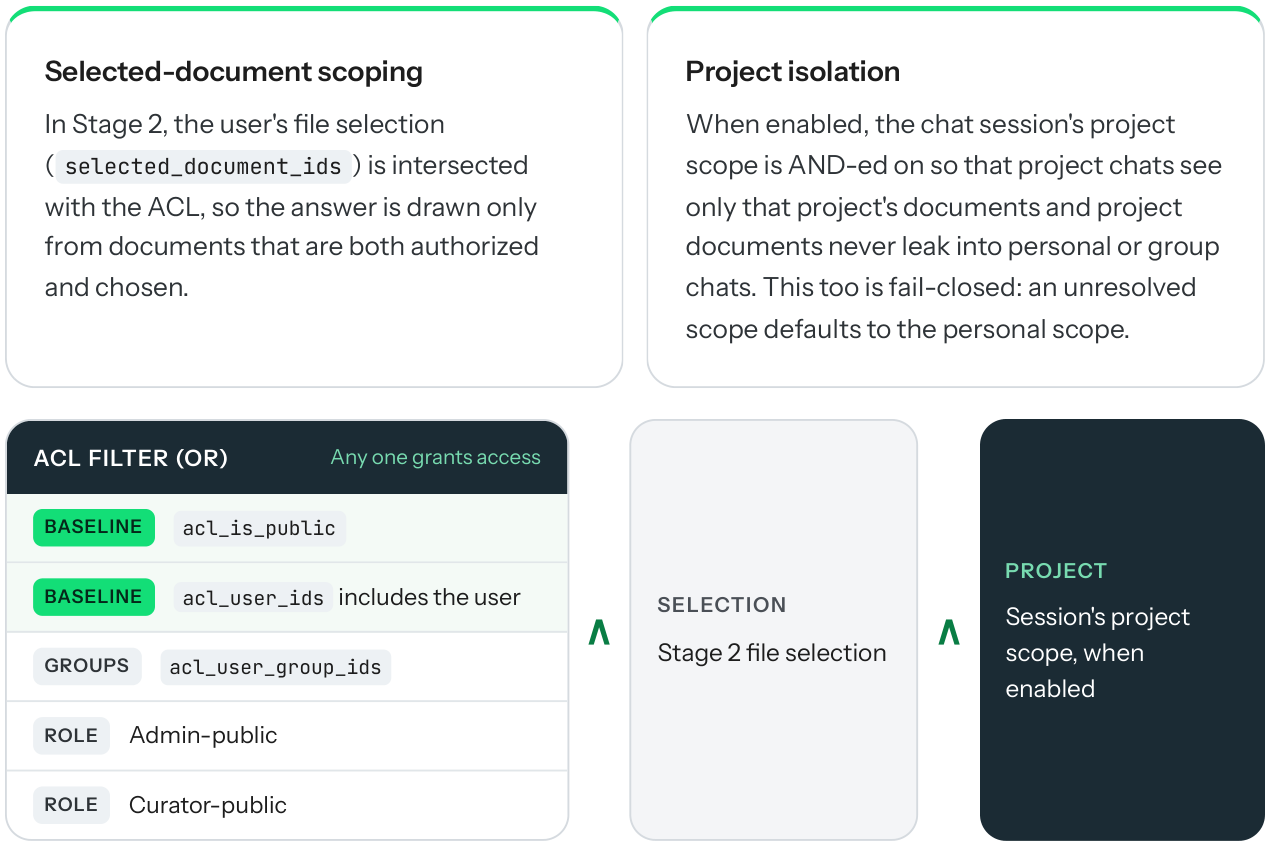
For each query, the system looks up the user's group membership and role and constructs a Qdrant payload filter with OR semantics covering:
documents marked public (acl_is_public);
documents whose acl_user_ids include the requesting user;
documents in any of the user's groups (acl_user_group_ids);
admin-public documents (for ADMIN / GLOBAL_CURATOR);
curator-public documents (for CURATOR / GLOBAL_CURATOR).
The design is fail-closed: even if the database lookup fails, the function still returns a non-empty baseline filter (public documents plus the user's own documents), so an error narrows what is visible rather than opening the corpus. On top of the ACL filter, two further filters are composed with AND semantics:

Read figure text
Selected-document scoping In Stage 2, the user's file selection (selected_document_ids) is intersected with the ACL, so the answer is drawn only from documents that are both authorized and chosen. | Project isolation When enabled, the chat session's project scope is AND-ed on so that project chats see only that project's documents and project documents never leak into personal or group chats. This too is fail-closed: an unresolved scope defaults to the personal scope. ACL FILTER (OR) Any one grants access BASELINE acl_is_public BASELINE acl_user_ids includes the user GROUPS acl_user_group_ids ROLE Admin-public ROLE Curator-public | SELECTION Stage 2 file selection | PROJECT Session's project scope, when enabled | ∧ ∧
Because these filters are pushed down into Qdrant as payload conditions, access control is applied at the vector-search layer: unauthorized documents are never even scored, let alone returned to the model.
Ingestion, chunking, and PII redaction
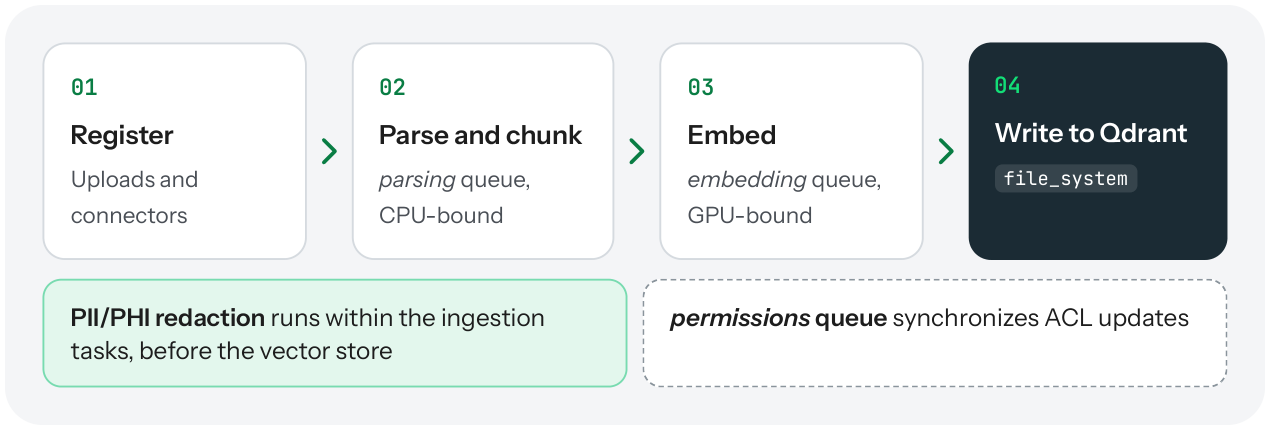
Retrieval quality is set at ingestion time. Corporate GPT ingests documents asynchronously through Celery workers backed by Redis, organized into dedicated queues (parsing, embedding, and permissions) so that CPU-bound parsing, GPU-bound embedding, and ACL synchronization scale independently. Files are first registered, then parsed and chunked, then embedded and written to Qdrant. The pipeline is GPU-aware (it defers work when free device memory is below a threshold), uses distributed locks to prevent duplicate processing across workers, and carries a bounded retry budget with a state machine that supports pause, resume, and stop of an in-flight source.

Read figure text
04 01 02 03 Write to Qdrant Register Parse and chunk Embed Uploads and parsing queue, embedding queue, file_system connectors CPU-bound GPU-bound PII/PHI redaction runs within the ingestion permissions queue synchronizes ACL updates tasks, before the vector store
Documents enter this pipeline either as direct uploads or through a connector platform that ingests from external systems of record (for example issue trackers, CRMs, and databases), normalizing each source into the same chunk-and-embed path. This is what makes the single unified file_system collection a genuinely cross-source corpus while keeping one retrieval and access-control code path.
6.1 Structure-aware chunking with Docling
Parsing and chunking use Docling's HybridChunker with a HuggingFace tokenizer (default chunk size 2048 tokens; connectors use a smaller default). The chunker is structure-aware: the engine preserves nested list indentation, re-wraps code blocks as complete fenced blocks (since token-splitting a code item would otherwise leave dangling fences), and splits large tables into token-bounded pieces while keeping them well-formed. This structural fidelity is what lets the downstream model reason over tables, code, and lists rather than over shredded text.
6.2 PII / PHI detection and redaction
Before content is indexed, it passes through a PII/PHI pipeline built on Microsoft Presidio with a spaCy NLP engine, exposing 50+ recognizers (SSN and credit card with Luhn validation, IBAN, bank and passport numbers, driver license, ITIN, crypto addresses, and country-specific identifiers such as Indian PAN and Aadhaar, among others). A policy separates entity types into an always-redact set (financial and government identifiers, redacted even when nested inside an otherwise-safe span such as a URL parameter) and a never-redact pass-through set (e.g. dates, locations, organizations, URLs, and email addresses that are safe to retain for retrieval context). Redacted spans are fingerprinted with an HMAC-SHA256 hash of the raw value, allowing consistent handling and audit without persisting the sensitive plaintext. This pipeline runs within the ingestion tasks so that sensitive data is scrubbed before it ever reaches the vector store.
- 50+ recognizers
- ALWAYS REDACT Financial and government identifiers, even when nested inside an otherwise-safe span
- NEVER REDACT Dates, locations, organizations, URLs, and email addresses safe to retain
6.3 Permission synchronization
Access-control changes propagate through the dedicated permissions queue, which batch-synchronizes ACL updates between the relational database and the Qdrant payloads and purges deleted users and groups from the index. This keeps the authorization metadata that the retrieval filters depend on consistent with the system of record.
Model orchestration and observability
7.1 Provider-agnostic model layer
All model calls flow through a resolution layer that maps a logical slot (chat, parsing, embedding, speech-to-text) to a concrete, centrally-configured model for the requesting user. Slots decouple role from implementation: the chat/answer model, the parser/reranker model, the embedding model, and the speech-to-text model can each be swapped independently, and the resolver enforces class constraints (e.g. multimodal answer generation requires a vision-capable VLM; embedding requires an embedding model). An optional extended-reasoning (“thinking”) mode is negotiated per request and downgraded gracefully when the resolved model does not support it. The net effect is that the same agentic RAG architecture runs unchanged against self-hosted open models (via vLLM or Ollama) or a commercial API such as Claude.
 View full size

Read figure text
SLOT Chat / answer Vision-capable VLM for multimodal | SLOT Parser / reranker | SLOT Embedding | SLOT Speech-to-text
7.2 Distributed tracing and evaluation
Every retrieval is instrumented. The RAG tool opens an OpenInference RETRIEVER span (exported to Phoenix) recording the query, the resolved top-k, whether deep search was active, the retrieval hop number, the number of sources returned, and end-to-end latency; failures are captured as error spans with exception detail. This gives operators a per-query, per-hop view of the agentic loop. Retrieval and answer quality are measured offline with a RAGAS-based evaluation harness, closing the loop between production traces and measured groundedness.
 View full size

Read figure text
SPAN RECORDS RETRIEVER Resolved top-k Query Deep search active Retrieval hop number Sources returned Error spans on failure End-to-end latency
7.3 RAGAS results
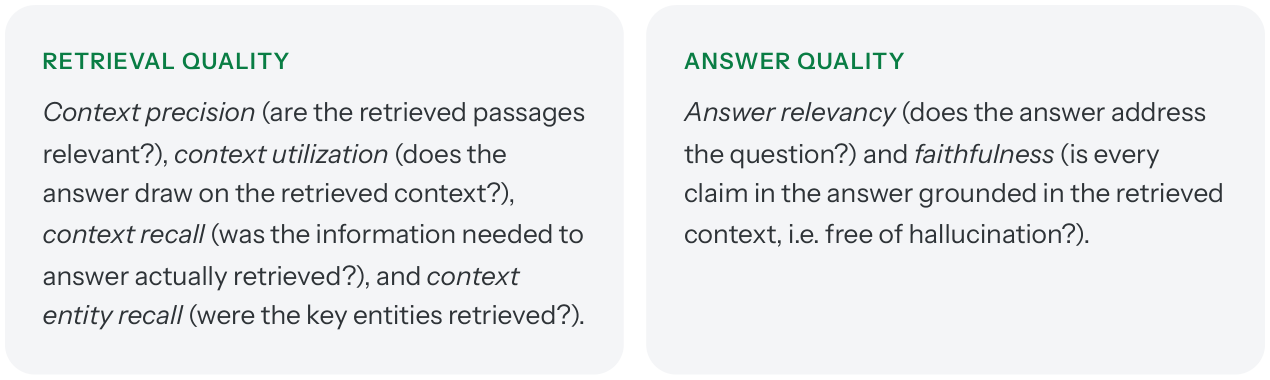
The RAGAS harness scores the end-to-end pipeline on two complementary families of metrics, all on a [0, 1] scale where higher is better:

Read figure text
RETRIEVAL QUALITY Context precision (are the retrieved passages relevant?), context utilization (does the answer draw on the retrieved context?), context recall (was the information needed to answer actually retrieved?), and context entity recall (were the key entities retrieved?). | ANSWER QUALITY Answer relevancy (does the answer address the question?) and faithfulness (is every claim in the answer grounded in the retrieved context, i.e. free of hallucination?).
| RAGAS metric | Qwen3.5 (40 Q) | Qwen3.6 (40 Q) | Qwen3.5 (221 Q) |
|---|---|---|---|
| Context precision | 0.750 | 0.713 | 0.625 |
| Context utilization | 0.789 | 0.695 | 0.668 |
| Context recall | 0.967 | 0.923 | 0.750 |
| Context entity recall | 0.356 | 0.266 | 0.200 |
| Answer relevancy | 0.825 | 0.646 | 0.668 |
| Faithfulness | 0.841 | 0.698 | 0.859 |
End-to-end request flow
Putting the pieces together, a typical document question proceeds as follows:
- The chat endpoint invokes the orchestrator agent with the user's message and identity.
- The orchestrator classifies the message. A greeting is answered directly; a web or Jira question is delegated to the corresponding agent; anything factual is treated as RAG-relevant.
- For a RAG-relevant question, the orchestrator calls the RAG agent, whose first hop is forced to retrieve. The retrieval tool builds the user's ACL (and project) filters and invokes the retrieval engine.
- The retrieval engine runs hybrid dense+sparse search over Qdrant with the ACL filter pushed down, fuses the channels (RRF by default), stitches and deduplicates results, optionally LLM-reranks under deep search, and budgets the final context.
- The orchestrator returns a preview of the matched files and chunks; the user selects which documents to use.
- On the follow-up turn, the RAG agent retrieves once more (now intersected with the selected document IDs) and generates a grounded, cited answer, which the orchestrator returns verbatim.
- Throughout, each retrieval is traced to Phoenix, and the retrieval budget bounds the number of hops.
Design principles
Three principles recur throughout the architecture:
 View full size

Read figure text
01 Groundedness over fluency The system is engineered to refuse rather than fabricate. Forced first-hop retrieval, the absolute grounding rule, and verbatim pass-through of the retrieval agent's answer all serve the same end: the answer the user reads is traceable to a retrieved source.
 View full size

Read figure text
02 Authorization by construction Access control lives inside the retrieval call and is pushed down into the vector store, is fail-closed on error, and is composed (ACL × selection × project) so that no single bug widens visibility. Sensitive personal data is removed before indexing.
 View full size

Read figure text
03 Observability and configurability Every retrieval is traced; every model is a resolvable slot; every agent is a registry entry. The system's behavior can be reconfigured (different models, different fusion strategy, different set of agents) without changing its code.
Conclusion
Corporate GPT demonstrates that agentic RAG in an enterprise setting is less about a single clever retrieval trick and more about control: control over when and how often to retrieve, over which specialized agent handles a request, over which documents a user may see, and over what data ever enters the index in the first place. By combining a planning orchestrator, a human-in-the-loop preview/select/answer flow, a hybrid and rerankable retrieval engine, pushed-down fail-closed access control, and full tracing, the system delivers answers that are grounded, authorized, and auditable: the properties that distinguish a trustworthy corporate knowledge assistant from a fluent guesser.
 View full size

Read figure text
THE RESULT Agentic RAG in an enterprise setting is less about a single clever retrieval trick and more about control.